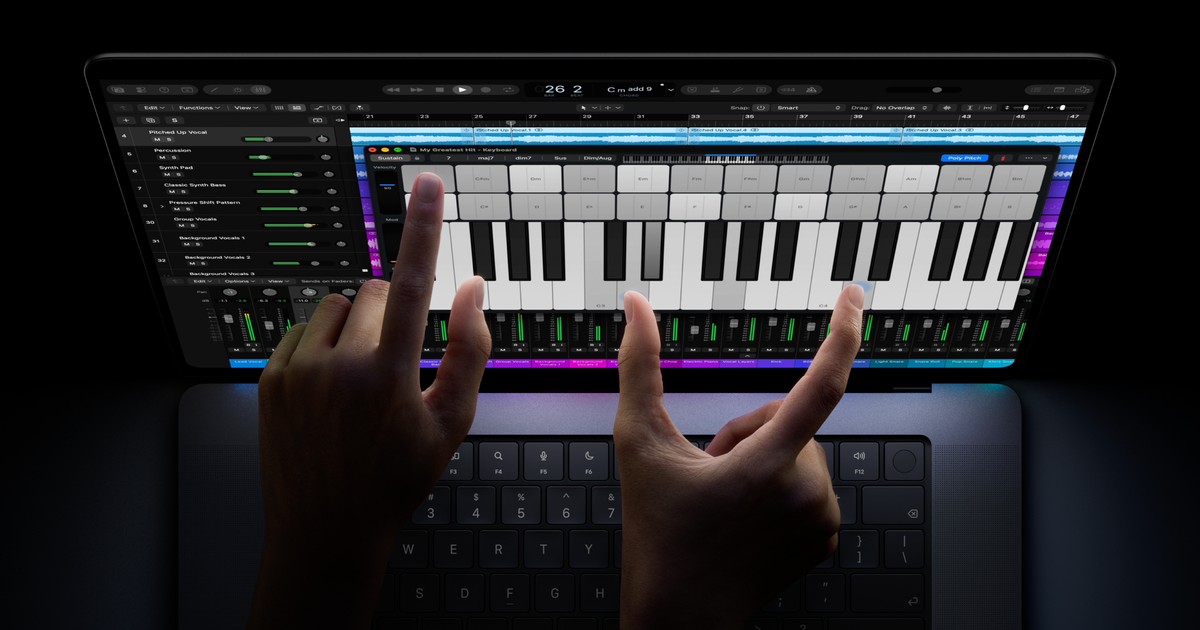
Apple’s new 14- and 16-inch MacBook Pro with PROLED XDR Display is not a routine processor bump. Announced October 28 for November 6 availability, it introduces tandem OLED, touch input and Dynamic Island to the Mac for the first time. Apple claims up to 2,000 nits of HDR and SDR peak brightness, a 10,000,000:1 contrast ratio and adaptive refresh up to 120Hz. Those are manufacturer specifications, not independent display tests. The product is available to pre-order now.
For photography, the significant change may be color management rather than touch. Apple says the panel covers both P3 and Adobe RGB and more than 80% of Rec. 2020, with calibration and reference modes for color-critical work. The touch interface could be useful for rotating a Plasticity model or interacting with an on-screen drawing, but the value depends on application support; it is not evidence that Plasticity has a new touch workflow today.
For development and AI work, M5 Pro and M5 Max support up to 128GB unified memory, up to 16TB storage and Thunderbolt 5. Apple emphasizes local inference of very large language models on M5 Max. Compare actual memory pressure and compilation performance on the existing M1 Max before assuming that advertised AI capability translates to better everyday performance. A new processor does not necessarily fix workflow bottlenecks caused by software or I/O.
The 14-inch M5 Pro starts at $2,899; the 16-inch M5 Pro starts at $3,399; 16-inch M5 Max begins at $4,799. The new 16-inch weighs approximately four pounds, versus heavier previous models, and Apple advertises up to 24 hours of battery life. Configuring a 16-inch M5 Max with enough unified memory for local AI will raise the price substantially above the base model.
The sensible evaluation is to open the official spec and configuration pages, choose an M5 Max memory/storage tier comparable to current usage, and ask three concrete questions: Is the screen materially better for editing? Does the local model you actually want fit in memory? Does touch save work in CAD? There is no reason to rush a pre-order until those answers are clear. Apple’s November 6 in-store date makes a hands-on comparison possible.
Go to Source — [www.apple.com](https://www.apple.com/newsroom/2026/10/apple-unveils-groundbreaking-macbook-pro-with-proled-xdr-display/) https://www.apple.com/newsroom/2026/10/apple-unveils-groundbreaking-macbook-pro-with-proled-xdr-display/ How to Try / Book — [www.apple.com](https://www.apple.com/shop/buy-mac/macbook-pro) https://www.apple.com/shop/buy-mac/macbook-pro