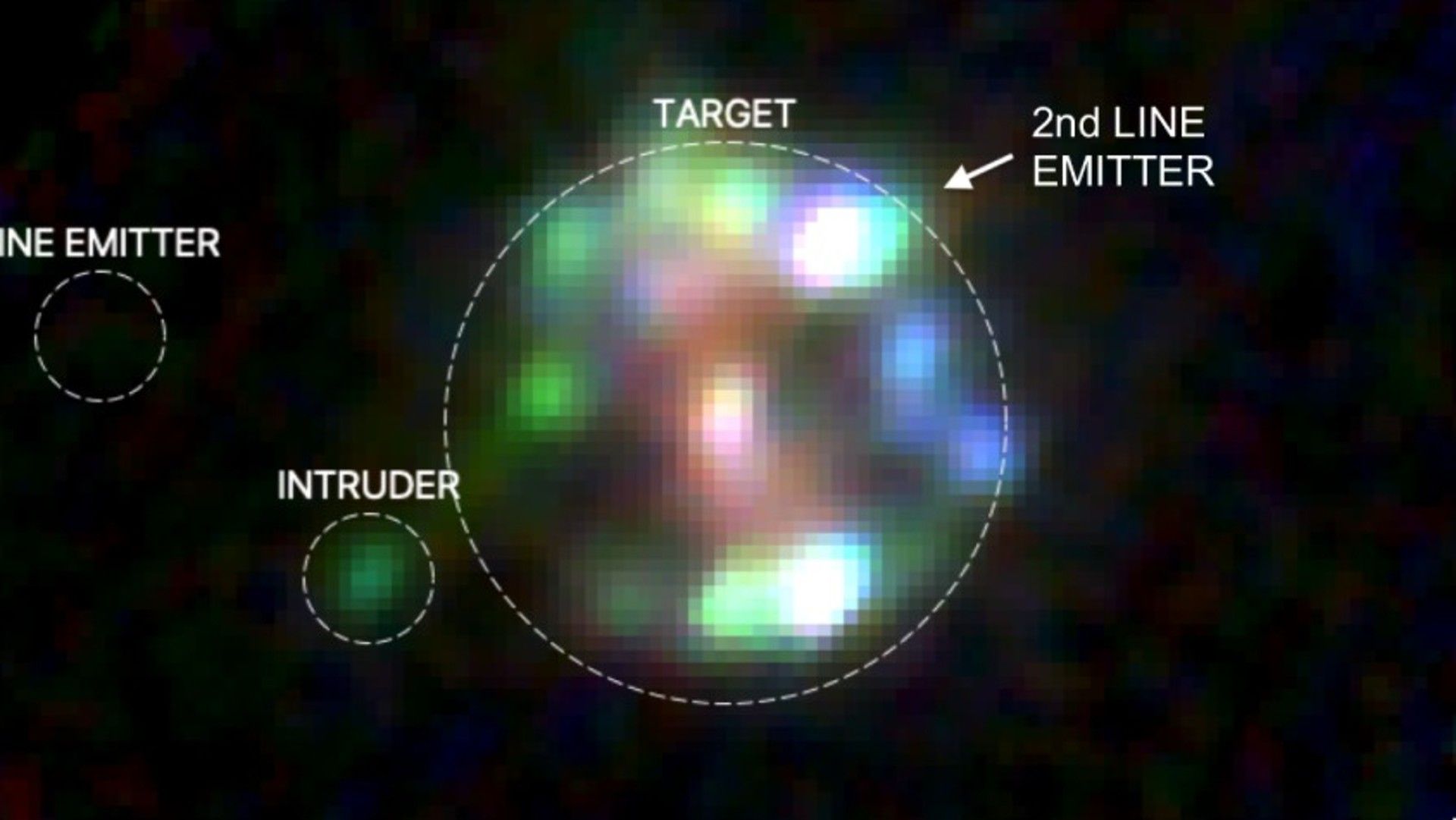
Researchers analyzing Webb spectroscopy identified GS18660, currently the most distant known ring galaxy. We see it as it existed around 2.1 billion years after the Big Bang. Its star-forming ring and expanding gas are consistent with a smaller galaxy having passed almost through the center of the larger one.
The evidence is more interesting than a dramatic illustration. The team measured a radial expansion component of about 200 kilometers per second, a companion receding around 425 kilometers per second, and a bridge of gas connecting the objects. They estimate a collision tens of millions of years before the light we observe was emitted. A resonance mechanism remains an alternative explanation, so the interpretation is strong but not certain.
The open-access Astronomy & Astrophysics paper has figures that let you follow the actual evidence. It is a good five-minute exploration of how scientists reconstruct a violent event that occurred billions of years ago from light and motion.
Open the research figure and compare the ring with the nearby intruder; the paper is freely accessible.