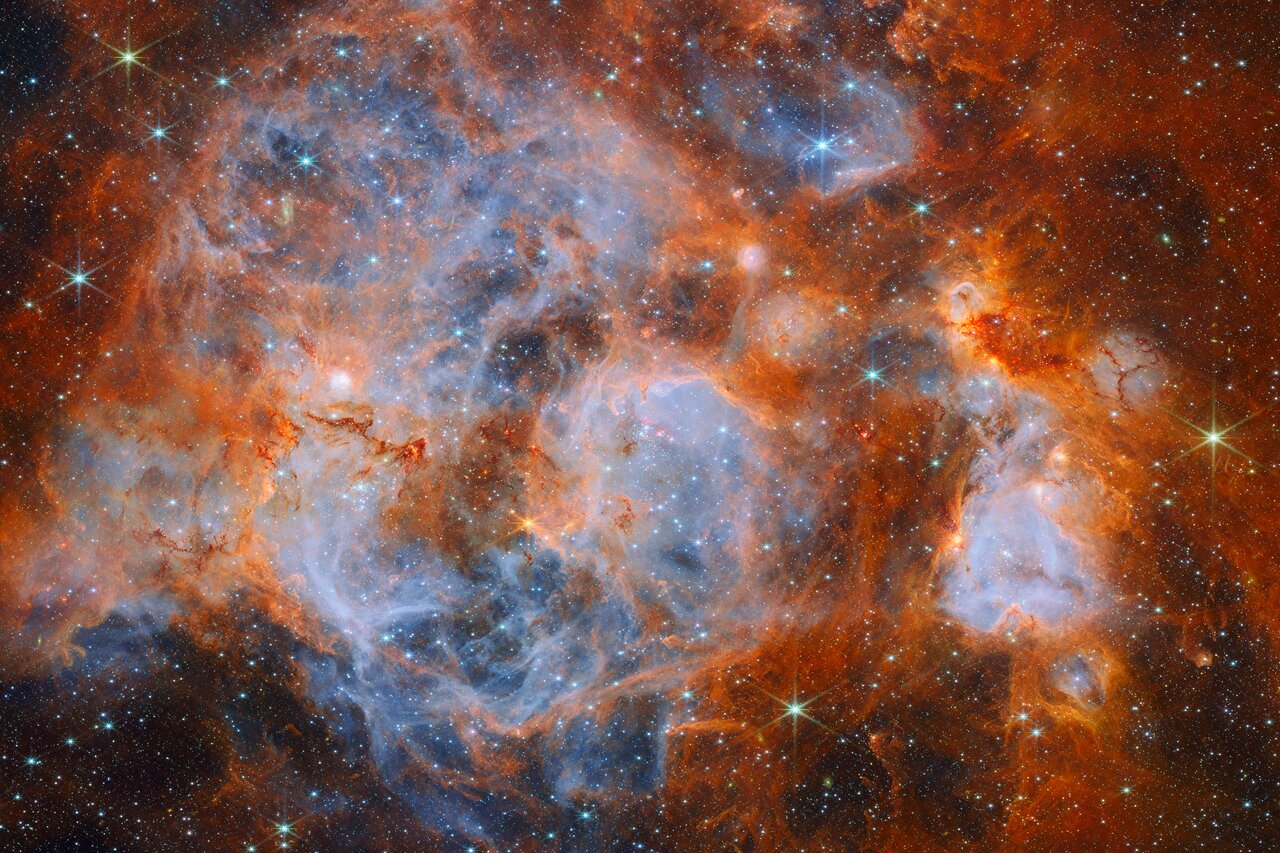
NASA and ESA highlighted a new Webb image of N159, a star-forming region 161,000 light-years away in the Large Magellanic Cloud. The image covers roughly 230 light-years and looks like a Halloween cauldron: pale blue gas swirls around orange clouds and dark red filaments. The colors trace different emissions and physical conditions, not a literal view a human eye would see from a spacecraft.
N159 is scientifically useful because the Large Magellanic Cloud contains fewer elements heavier than hydrogen and helium than our galaxy. Astronomers can compare how stars form there with conditions in the earlier universe. ESA offers a zoomable image, large downloads and pan-and-zoom videos, making this more than a headline photograph.
The creative payoff is immediate. Study how the bright blue wisps, dark structures and clustered points of light guide the eye. It is a compelling example of layered composition from real data and a worthwhile desktop-wallpaper candidate.
Open ESA’s full-resolution N159 image and zoom video; use it as a reference for color, layering and photographic composition.