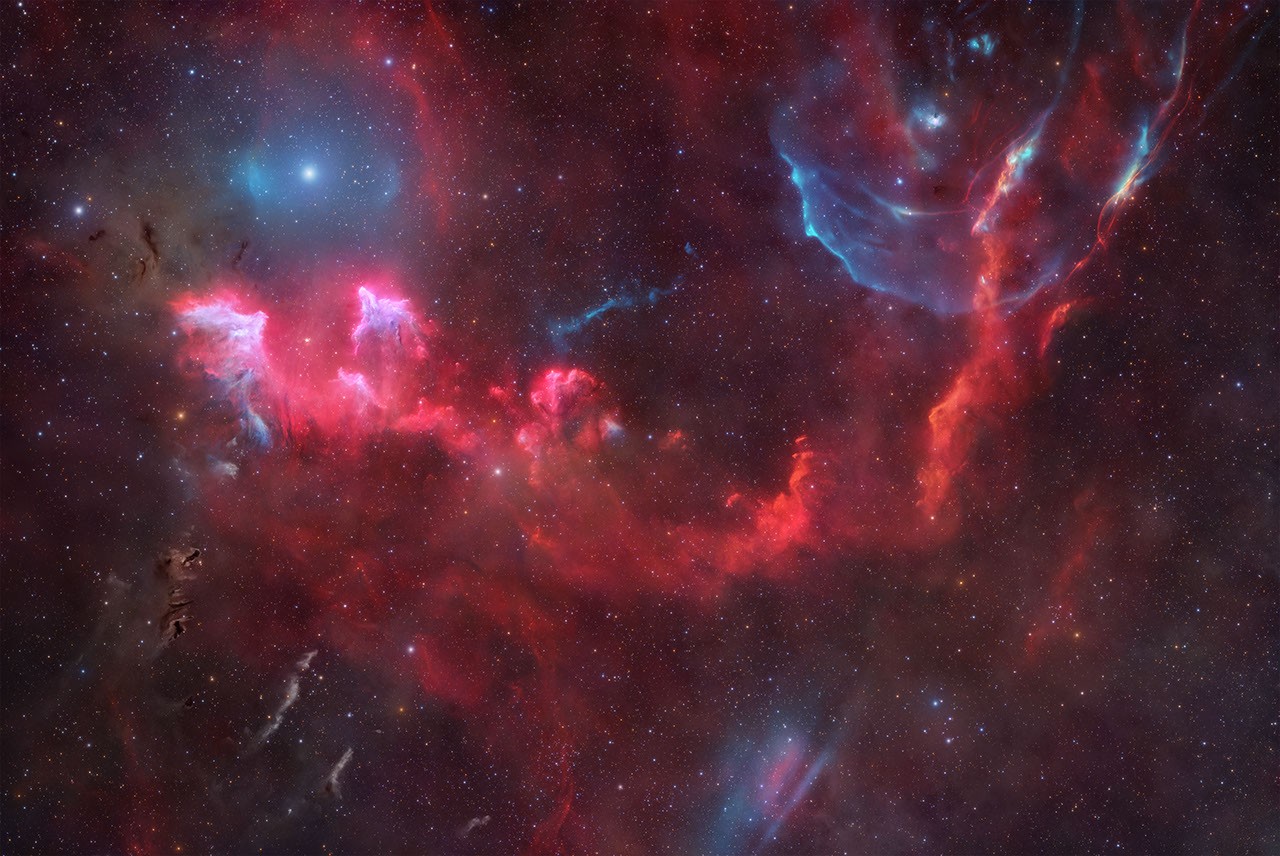
NASA’s October 21 Astronomy Picture of the Day shows the familiar Ghosts of Cassiopeia, IC 59 and IC 63, alongside three faint newly highlighted objects. The team accumulated roughly 100 hours of observations and used an oxygen-sensitive filter to reveal blue emissions that ordinary photographs miss.
The science is as good as the visual: one blue structure might be a bow shock created as the bright star Gamma Cassiopeiae moves through interstellar material. Another might turn out to be a planetary nebula if a central white dwarf is identified. NASA emphasizes that these interpretations are not yet settled.
For a photographer, the lesson is that filter choice and integration time can reveal a different physical layer of the same scene. Compare the annotated and unannotated images and look at the way the blue oxygen structures differ from the red hydrogen glow.
What to do: Open today’s APOD and compare its annotated and original versions at full resolution.