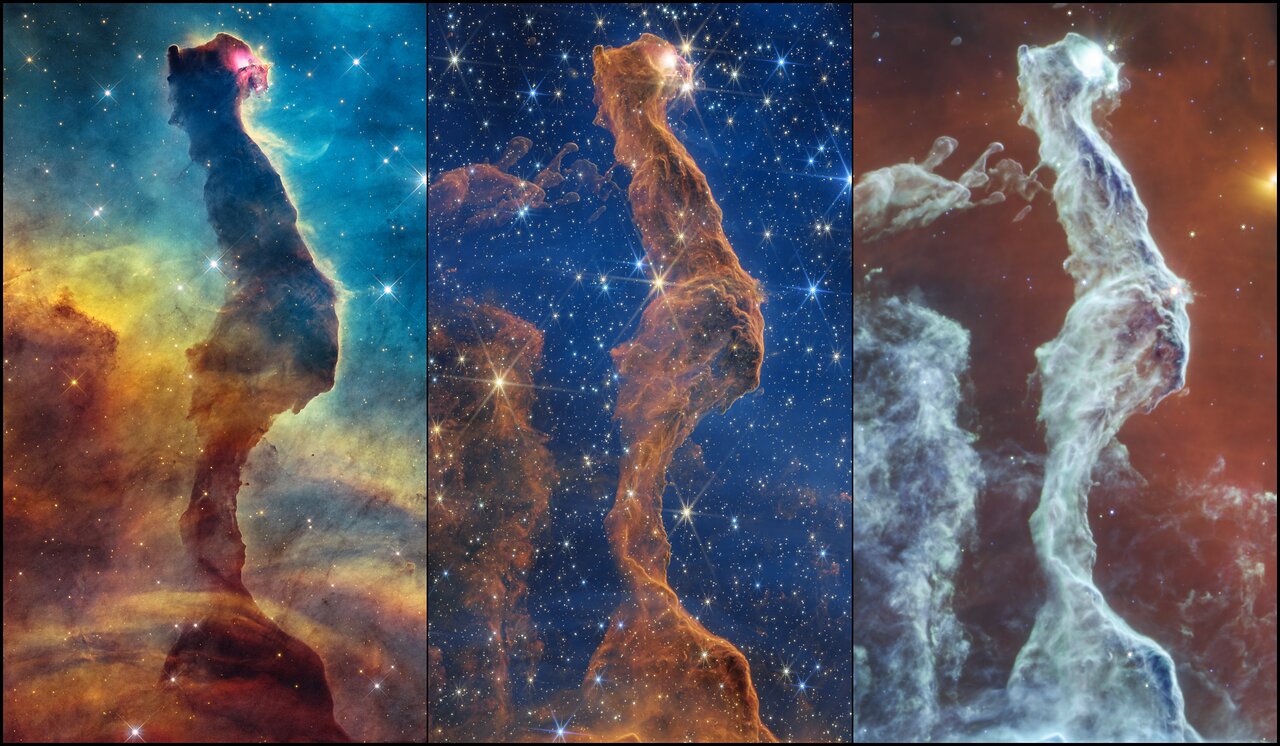
On October 29, ESA published new Hubble and James Webb views of the Cat’s Head Nebula, a star-forming structure in the Carina Nebula about 7,500 light-years away. Hubble sees a dark pillar and a glowing red “eye”; Webb’s infrared views uncover many more stars and layers of dust.
The science is in the comparison. Ultraviolet radiation from massive stars sculpts the pillar, while the denser material resists erosion. Near-infrared light exposes embedded stars, and mid-infrared light maps warm dust and carbon-based molecules. These are different wavelengths revealing different physical processes, not just alternate color treatments.
ESA’s primary release includes full-resolution images, a zoom video and a slider comparing telescope views. Open that interactive comparison rather than relying on a cropped news thumbnail; it is an excellent example of how multiple sensors change our understanding of the same object.
Go to Source — [esawebb.org](https://esawebb.org/news/weic2622/) https://esawebb.org/news/weic2622/